Texas · Auto insurance
Comprehensive vs. Collision Coverage: What Each One Pays For
Two coverages protect your own car, and they answer two different kinds of bad day. Here is which one pays for what, how the deductible fits in, and how to decide whether you still need both.

In short
Collision coverage pays to repair or replace your car after it hits another vehicle or an object, or rolls over, no matter who was at fault. Comprehensive coverage pays when your car is stolen or damaged by something other than a collision, such as hail, flood, fire, vandalism, a falling tree or hitting an animal. Texas law requires neither, but a lender or leasing company will require both.
- Collision covers crashes with a vehicle or object, rollovers and pothole damage, regardless of fault.
- Comprehensive covers theft, fire, flood, hail, vandalism, falling objects and hitting an animal.
- Neither is required by Texas law, but a lender or lessor will require both until the car is paid off.
- Each coverage has its own deductible, and neither has a dollar limit: the most it pays is the car's current value.
- Hitting a deer is a comprehensive claim. Swerving and hitting a guardrail is a collision claim.
In this article
- What does collision coverage pay for?
- What does comprehensive coverage pay for?
- Which coverage pays for which kind of damage?
- What do neither of them pay for?
- How do the deductibles and payout limits work?
- How does a claim play out in real numbers?
- Do you have to carry both?
- What should you check on your own policy today?
You are looking at your auto policy and see two lines that both seem to protect your car, each with its own price and its own deductible. Collision pays when your car hits something or rolls over. Comprehensive pays when something else happens to it: hail, theft, flood, fire, vandalism or an animal in the road.
What does collision coverage pay for?
Collision coverage pays to repair or replace your car after an accident. The Office of Public Insurance Counsel describes it as coverage for damage to your car when you hit something, regardless of who is at fault.
That includes more than a crash with another vehicle. The Insurance Information Institute lists hitting an object such as a pole, a guardrail or a mailbox, flipping the car over, and damage from potholes as collision losses.
Collision is about your car only. Damage you cause to someone else's car, fence or building is paid by your liability coverage, which is the part Texas law requires. If you want a refresher on that part, see what the 30/60/25 rule requires.
What does comprehensive coverage pay for?
Comprehensive is sometimes printed on a policy as “other than collision,” and that name explains it well. The Texas Department of Insurance (TDI) says it pays if your car is stolen or damaged by fire, flood, vandalism or something other than a collision. TDI's list of covered damage also names hail, flying gravel and hitting an animal.
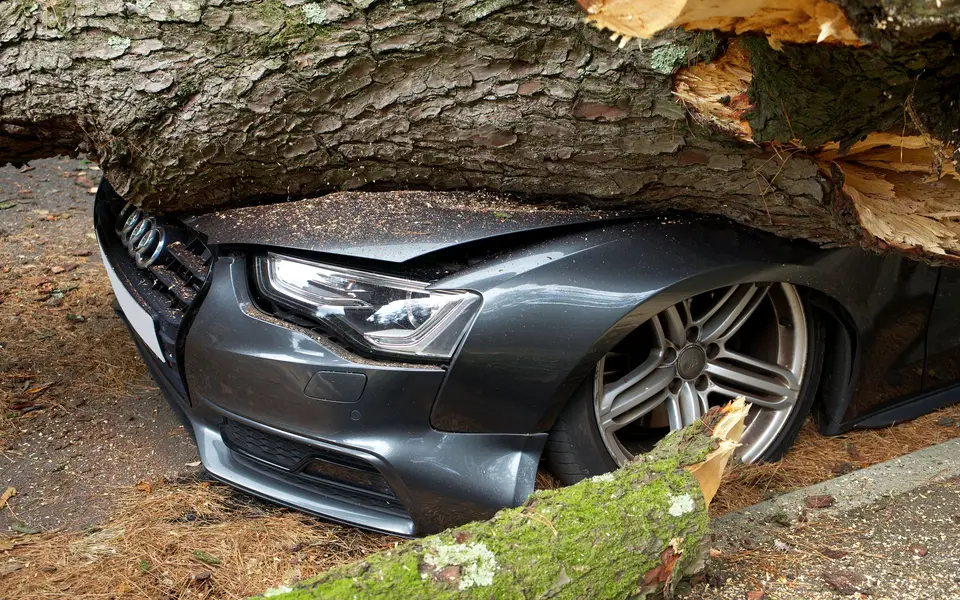
The Insurance Information Institute adds falling objects such as trees and branches, natural disasters such as tornadoes and floods, riots, a broken windshield, and theft of the whole car or of parts.
In North Texas, comprehensive is the coverage that does the heavy lifting. Spring hail, a tree limb that comes down in a storm, and street flooding after a downpour are all comprehensive losses. We cover those claims in detail in how a hail damage claim on your car works and whether a flooded car is covered.
Which coverage pays for which kind of damage?
Most confusion comes from a handful of situations that feel like one coverage and are actually the other. The cause of the damage decides which coverage applies, and that decides which deductible you pay.
Common situations and the coverage that usually responds
| What happened | Coverage that usually applies |
|---|---|
| You rear-end another car in traffic | Collision for your car, liability for theirs |
| You back into a pole in a parking garage | Collision |
| Your car rolls over on a wet ramp | Collision |
| A pothole bends a wheel and damages the suspension | Collision |
| Hail dents the hood and roof | Comprehensive |
| The car is stolen from your driveway | Comprehensive |
| A tree limb falls on the car in a storm | Comprehensive |
| The car is caught in rising water | Comprehensive |
| You hit a deer on a dark road | Comprehensive |
| You swerve to miss the deer and hit a fence | Collision |
| Gravel from a truck cracks the windshield | Comprehensive |
What this means for you: before you file, think about what caused the damage, because that sets the deductible you will pay. If your two deductibles are different, the same repair bill can leave you with a very different out-of-pocket cost.
Glass has its own wrinkles, including when a small repair is worth a claim at all. See whether insurance covers a cracked windshield.
What do neither of them pay for?
Comprehensive and collision are both “physical damage” coverages. They pay for your car, up to what it is worth, and nothing else.
- Other people's injuries and property. That is liability coverage.
- Your own medical bills. That is personal injury protection or medical payments coverage.
- Belongings inside the car. TDI says your auto policy will not pay for items stolen from your car, though a homeowners or renters policy might.
- A rental car while yours is in the shop. That is rental reimbursement, a separate coverage with daily and total dollar limits. TDI notes that comprehensive can pay for a rental when your car is stolen, so check that part of your policy.
- Towing after a breakdown. That is towing and labor coverage.
- The balance of your loan if it is higher than the car's value. That shortfall is what gap coverage is for, and we explain it in whether you need gap insurance on a financed or leased car.
- Wear and tear and mechanical breakdown. Insurance responds to a sudden covered loss, not to parts wearing out.
Every policy has its own wording and exclusions. If a term on your declarations page is unfamiliar, our insurance glossary explains the common ones in plain language.
How do the deductibles and payout limits work?
TDI points out that collision and comprehensive do not have dollar limits the way liability does. The ceiling is the car itself: a standard policy typically pays the cost of repair, or the car's current value if it is totaled, minus your deductible.
You choose a deductible for each coverage separately, and it applies each time you file a claim. TDI's own example: on a $1,500 collision claim with a $500 deductible, the company pays $1,000.
How the two coverages compare side by side
| Question | Collision | Comprehensive |
|---|---|---|
| Required by Texas law? | No | No |
| Required by a lender or lessor? | Yes, in nearly every loan or lease | Yes, in nearly every loan or lease |
| Does fault matter? | No, it pays even when you caused the crash | No, these losses are usually nobody's fault |
| Deductible | Chosen separately | Chosen separately |
| Most it pays | The car's current value, minus the deductible | The car's current value, minus the deductible |
| Typical North Texas claim | A crash on I-35E or US-75 | Hail, theft, a fallen limb, high water |
What this means for you: the two deductibles do not have to match. Think about which loss is more likely where you live and park, and set each deductible with that in mind. Our guide on how to choose a car insurance deductible walks through the math.
When repair costs come close to or pass the car's value, the company will likely total it and pay the value instead. How that value is set is its own subject: see how the insurance company decides what to pay on a totaled car.
How does a claim play out in real numbers?
Here is an example with round numbers. It is an illustration, not a quote.
Say you drive a sedan worth $18,000 and carry a $500 comprehensive deductible and a $1,000 collision deductible.
- April hailstorm. Hail leaves $4,200 in dents and a cracked windshield. This is a comprehensive claim. The policy pays $4,200 minus $500, or $3,700. You pay the shop the $500.
- A crash in stop-and-go traffic. In August you rear-end a pickup. Your repair is $6,000. This is a collision claim. The policy pays $6,000 minus $1,000, or $5,000. The pickup's damage is paid by your liability coverage, and no deductible applies to that part.
- Someone else hits you. In December another driver runs a light and causes $3,000 in damage to your car. Their liability insurance should pay the full $3,000, and you owe no deductible on a claim against another driver's company. If their company stalls, you can use your own collision coverage, pay the $1,000 deductible, and let your company seek repayment. TDI says that if it recovers the money, you will probably get your deductible back.
Now picture the same year with liability only. The hail damage and your own crash repair, $10,200 together, would come out of your pocket. In the third case you would have to wait on the other driver's company, with no coverage of your own to fall back on unless you carried uninsured motorist property damage. For more on that coverage, read whether uninsured motorist coverage is worth it.
Do you have to carry both?
Texas does not require either one. Your lender almost certainly does.
TDI states it plainly: if you still owe money on your car, your lender will require collision and comprehensive. If you cancel or lose them, the lender can buy single-interest coverage and add the cost to your loan payment. TDI describes that coverage as expensive and as protecting only the lender. The same requirement applies when you lease.
Once the car is paid off, the choice is yours. This checklist helps you decide:
- Look up what the car is worth today. That figure, minus your deductible, is the most either coverage would ever pay.
- Find the yearly cost of each coverage on your declarations page. They are priced separately.
- Compare the two. The Insurance Information Institute offers a rule of thumb: if the car is worth less than 10 times the premium, the coverage may not be cost effective.
- Ask whether you could replace the car from savings next month without a loan. If not, the coverage is still doing a job for you.
- Weigh comprehensive separately. In hail country, some owners of older cars keep comprehensive and drop only collision. Ask your company which combinations it sells.
The wider question of when to move an older car to liability only is covered in full coverage vs. liability-only car insurance in Texas.
What should you check on your own policy today?
Pull out your declarations page and look for these items. It takes five minutes.
- Are comprehensive (or “other than collision”) and collision both listed for each car?
- What is the deductible on each one, and could you pay it this week?
- Is there separate wording or a separate deductible for glass?
- Do you have rental reimbursement and towing, or have you been assuming they come with “full coverage”?
- If you have a loan or lease, is the lender listed correctly as lienholder or loss payee?
- If you owe more than the car is worth, do you have gap coverage somewhere?
If you recently bought a car, TDI says your current policy automatically covers it for about 20 days, with the same coverage as the car it replaces. Tell your company right away so you are not caught with a gap. Everything else our auto insurance team reviews with drivers starts from that same page.
How Assured Insurance Group helps
Assured Insurance Group helps drivers in Flower Mound, Plano, Garland and across Dallas–Fort Worth with auto insurance, along with home and personal insurance, commercial and life insurance. We will walk through your current policy with you, show you what your comprehensive and collision coverages and deductibles are today, and go over your options. You can call, email info@assuredinsgroup.com, or visit our Flower Mound office. To get started, request a quote or call 214-222-5234.
Questions people ask next
Is hitting a deer a collision or a comprehensive claim?
Hitting an animal is a comprehensive claim, even though it feels like a collision. The Texas Department of Insurance says you are covered if you have comprehensive coverage and that you will probably pay your deductible. If you swerve to miss the animal and hit a tree or guardrail instead, that is a collision claim, paid under your collision coverage and its deductible.
Does Texas require comprehensive or collision coverage?
No. Texas law requires liability coverage of at least 30/60/25, which pays for damage and injuries you cause to other people. Comprehensive and collision are optional under state law. If you have a loan or a lease, though, your lender or leasing company will require both, and can buy coverage that protects only the lender and bill you for it if you drop them.
Can I buy comprehensive without collision?
It depends on the company. The two coverages are priced and listed separately, and some owners of older, paid-off cars ask to keep comprehensive for hail, theft and flood while dropping collision. Each company sets its own rules on which combinations it sells, so ask what is available before you change anything, and check your loan or lease terms first.
Will a comprehensive claim raise my rate?
It can. The Texas Department of Insurance says a company cannot drop you for a claim such as hitting an animal, and cannot refuse to renew your policy because of weather damage, but it could raise your rate at renewal. Each company decides how claims affect its pricing, so ask how a claim of that type would be treated before you file a small one.
Does comprehensive cover things stolen from inside my car?
Usually not. Comprehensive covers the car itself and its parts if they are stolen. The Texas Department of Insurance says your auto policy will not pay for items stolen from your car, but your homeowners or renters policy might. If you carry tools, a laptop or sports gear in the car, check the personal property section of that policy.
If another driver hits me, do I need my own collision coverage?
The other driver's liability insurance should pay for your repairs, and you pay no deductible on a claim against another driver's company. If that company refuses or delays, you can file with your own company only if you carry collision coverage. Your company will usually try to recover the money from the other insurer, and if it does you will probably get your deductible back.
Sources and further reading
- Texas Department of Insurance: Auto insurance guide
- Texas Department of Insurance: Texas auto insurance FAQ
- Office of Public Insurance Counsel: Auto insurance basics
- Insurance Information Institute: What is covered by collision and comprehensive auto insurance?
- Insurance Information Institute: Nine ways to lower your auto insurance costs
- Texas Department of Insurance: Hail damage to your home or car? What to do next
General information for Texas readers, current as of October 2026. It is not legal, tax or insurance advice. Your coverage depends on the wording of your own policy.
More auto insurance guides
- Do You Need Gap Insurance on a Financed or Leased Car in Texas?
- SR-22 Insurance in Texas: What It Is, Who Needs It and How Long
- What Happens If You Drive Without Insurance in Texas?
- Does Your Car Insurance Cover Someone Else Driving Your Car in Texas?
- Do You Need the Rental Car Company's Insurance If You Have Your Own Policy?
- Rideshare Insurance in Texas: What Uber and Lyft Drivers Need to Know