Texas · Home insurance
Tornado Damage in North Texas: What Your Home Insurance Pays For
A tornado claim touches almost every part of a home policy at once. Here is which coverage pays for what, what comes out of your pocket and what the company owes you by when.

In short
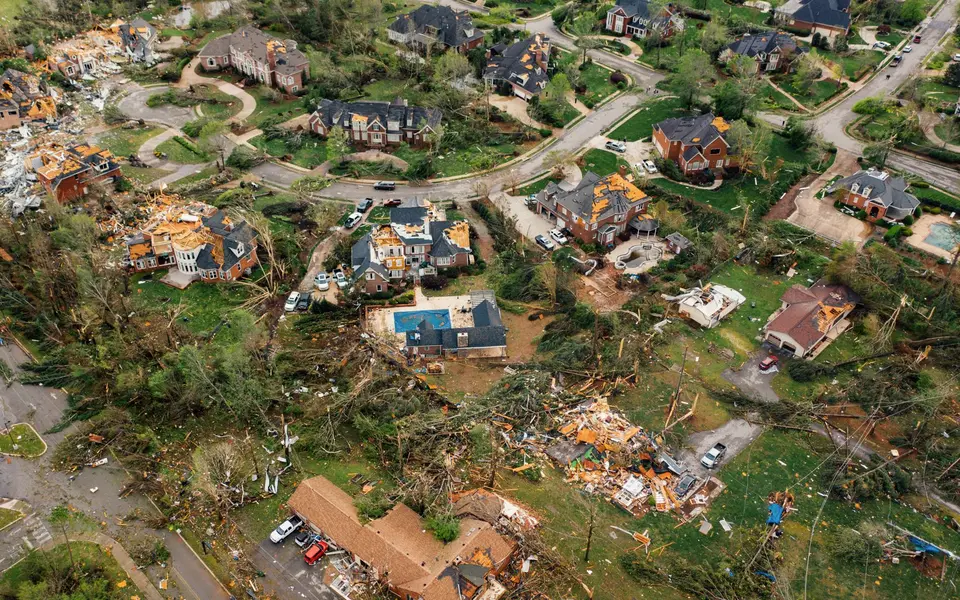
Most North Texas homeowners policies cover tornado damage because a tornado is a windstorm, a standard covered peril away from the Gulf Coast. The policy pays to repair the house, other structures, belongings and extra living costs, each up to its own limit, after your wind and hail deductible. Flooding from the same storm is not covered, and damage to your car goes through auto insurance.
- A tornado is covered as windstorm on most home policies outside the coastal windstorm area.
- Your wind and hail deductible applies, and it is often a percentage of the dwelling amount, not a flat figure.
- Detached garages, sheds and fences fall under other structures, typically up to 10% of the dwelling amount.
- Additional living expenses are usually limited to 10% to 20% of the dwelling amount.
- Texas gives the company 15 business days to accept or deny after it has your information, and five business days to pay.
In this article
- Does home insurance cover tornado damage in North Texas?
- What does each part of the policy pay for after a tornado?
- Which deductible applies, and how much will you pay yourself?
- What should you do in the first days after a tornado?
- How fast does the insurance company have to act in Texas?
- What if the house is a total loss?
- How do you avoid repair scams after a storm?
- What about your car?
Service: Home & Personal Insurance in Flower Mound, Plano and Garland
A tornado has damaged your home, or you want to know where you would stand if one did. On most North Texas homeowners policies tornado damage is covered, because it is wind. What you actually receive depends on four things on your declarations page: the wind and hail deductible, how the roof is settled, the dwelling amount and the limit for living expenses.
Does home insurance cover tornado damage in North Texas?
Yes, on most policies. The Texas Department of Insurance (TDI) lists windstorm, hurricane and hail among the risks most home policies cover, with one exception: homes on the Gulf Coast, where wind and hail coverage is sold separately. In Denton, Collin and Dallas counties, wind is normally part of the home policy itself.
It is not a remote risk here. The National Weather Service office in Fort Worth confirmed 12 tornadoes on December 26, 2015, including an EF4 that tracked through Sunnyvale, Garland and Rowlett and caused 10 deaths. On October 20, 2019, a tornado rated EF3, with winds near 140 mph, cut a path from I-35E and Walnut Hill through Preston Hollow to US-75 and Forest Lane and on into Richardson.
Two limits apply to every tornado claim. The policy pays only up to the dollar limit on each coverage, and it does not pay for flood, which most home policies exclude. See whether you need flood insurance in Texas if water could reach your street.
What does each part of the policy pay for after a tornado?
A tornado rarely damages one thing. TDI describes six coverages in most Texas home policies, and a tornado claim can draw on several at once.
How a typical home policy responds to tornado damage
| What was damaged | Coverage that responds | Typical limit or condition |
|---|---|---|
| Roof, walls, windows, garage attached to the house | Dwelling | Up to the dwelling amount, minus the wind and hail deductible |
| Detached garage, shed, fence | Other structures | Often up to 10% of the dwelling amount; fences usually at actual cash value |
| Furniture, clothes, electronics | Personal property | A percentage of the dwelling amount; replacement cost only if your policy says so |
| Hotel, rent, extra food costs while you are out of the house | Additional living expenses | Usually 10% to 20% of the dwelling amount |
| Tree on the house or blocking the driveway | Dwelling and debris provisions | Many policies pay for removal in those two cases; a tree down in the yard usually is not covered |
| Spoiled food after the power failed | Personal property provision | Often up to $500 or more, frequently with no deductible |
| Your car in the driveway | Not the home policy | Comprehensive coverage on your auto policy |
What this means for you: one storm can mean one home claim with several coverages inside it, plus a separate auto claim. Each coverage has its own cap, so a low other-structures or living-expense limit can run out even when the dwelling amount is high.
The full list of what a standard policy includes and leaves out is in what homeowners insurance covers in Texas. Terms such as actual cash value and declarations page are defined in our insurance glossary.
Which deductible applies, and how much will you pay yourself?
A tornado is a wind loss, so the wind and hail deductible applies. On many Texas policies that deductible is a percentage of the dwelling amount rather than a flat dollar figure, and it is separate from the deductible for fire or theft. The mechanics are covered in wind and hail deductibles in Texas.
A worked example with round numbers. This is an illustration, not a quote or a prediction.
A home is insured for $400,000 with a 2% wind and hail deductible and additional living expenses of 20%.
- Wind and hail deductible: 2% of $400,000 is $8,000.
- Other structures limit at 10%: $40,000.
- Additional living expenses limit at 20%: $80,000.
A tornado removes much of the roof, breaks windows and flattens the fence. Repairs to the house are estimated at $90,000 and the fence at $6,000. The family spends four months in a rental at a cost of $12,000 above their normal living costs.
On the house, $90,000 minus the $8,000 deductible leaves $82,000. The fence is settled at actual cash value, so if depreciation is $2,000, it pays $4,000. Living expenses of $12,000 are well inside the $80,000 limit. The family’s main out-of-pocket cost is the $8,000 deductible plus the fence depreciation.
Now change one fact. If the roof is covered at actual cash value instead of replacement cost, depreciation on an older roof comes out of the payment too. That single setting can move the result by thousands of dollars, as shown in replacement cost vs. actual cash value on a Texas roof.
What should you do in the first days after a tornado?
TDI’s storm recovery guidance comes down to these steps, in this order.
- Make sure everyone is safe and stay out of rooms with structural damage or downed power lines nearby.
- Report the claim to your agent or company as soon as you can. Ask about an advance payment if you need money quickly.
- Take photos and video of everything, inside and out, before anything is moved.
- Prevent more damage. Cover broken windows and holes in the roof and remove standing water. Temporary repairs are fine; permanent ones should wait for the adjuster.
- Keep damaged items until the adjuster has seen them, and keep receipts for every repair and every living cost.
- Make yourself easy to find. Give the company a working phone number, and post your address where it can be seen from the street if signs and mailboxes are gone.
- Be there for the adjuster’s visit and point out all the damage. TDI suggests having your contractor present.
- Get more than one bid and compare them with the adjuster’s estimate before you settle.
If the storm was mostly hail with roof damage and no structural loss, the process is narrower. That version is in the hail roof claim, step by step.
How fast does the insurance company have to act in Texas?
Texas law sets deadlines, and TDI lists them in its home insurance guide.
Claim deadlines for Texas home insurance companies
| Step | Deadline |
|---|---|
| Tell you it received your claim | Within 15 days |
| Accept or deny the claim | Within 15 business days after it has all the information it needs |
| Extra time to decide, if it tells you the reason | Up to 45 days |
| Pay after it agrees to pay | Within five business days |
| Mortgage company releases insurance money after it has what it asked for | Within 10 days |
What this means for you: the clock for a decision starts when the company has what it asked for, so send documents quickly and keep dated copies. TDI notes that deadlines may be longer after major disasters, and a tornado outbreak often qualifies.
Expect two checks if you have replacement cost coverage. The first is the repair estimate minus depreciation and your deductible. The second, for the depreciation that was held back, comes after the work is finished and billed. If you owe money on the home, the check is made out to you and the mortgage company together.
If you disagree with the amount, TDI describes three routes: ask for an appraisal when the dispute is about the amount rather than coverage, file a written complaint with TDI, or go to court. For disaster damage you must notify the company in writing at least 61 days before you sue, so speak with an attorney early if you are heading that way. Our article on a denied homeowners claim in Texas goes through each option.
What if the house is a total loss?
Then the dwelling amount is the ceiling, and whether it is high enough was decided the day you bought or renewed the policy. TDI says most companies require you to insure a house for at least 80% of its replacement cost, and some require 100%. If the limit is short of what rebuilding costs, you pay the difference.
Three things are worth checking now, before any storm:
- The dwelling amount against today’s rebuilding cost, not the market value or the tax appraisal. See how much homeowners insurance you need.
- Endorsements. TDI lists common add-ons that cover extra construction costs to meet local building codes and extra costs if the policy does not pay enough to rebuild.
- The living-expense limit. A full rebuild can take many months, and TDI warns that once you reach the limit you pay the rest yourself.
A list of belongings matters most in a total loss, because you will be asked to itemize what you owned. If you do not have one, make a home inventory this month.
How do you avoid repair scams after a storm?
Contractors arrive in damaged neighborhoods within hours, and not all of them are honest. TDI’s warnings are specific:
- It is illegal under Texas law for a contractor or roofer to offer to waive your deductible or promise a rebate for it. Your company may ask for proof, such as a receipt or canceled check, that you paid it.
- Get multiple bids and check references.
- Do not pay in full up front, and do not make the final payment until the work is done.
What about your car?
A car crushed by a tree or battered by debris is not part of the home claim. TDI confirms that your auto policy pays if you carry comprehensive coverage. That is a separate claim with its own deductible under your auto insurance, and it is one more reason to check both policies before spring.
How Assured Insurance Group helps
Assured Insurance Group helps homeowners in Flower Mound, Plano, Garland and across Dallas–Fort Worth with home and personal insurance. Before storm season, we will walk through your current policy with you: the wind and hail deductible in dollars, how the roof is settled, the dwelling amount and the living-expense limit, along with your options. Call us, email info@assuredinsgroup.com or visit our office on West Kingsley Street. To review your home insurance before the next warning, request a quote or call 214-222-5234.
Questions people ask next
Do I need separate tornado insurance in Dallas–Fort Worth?
No. There is no separate tornado policy. The Texas Department of Insurance lists windstorm, hurricane and hail among the risks most home policies cover, except along the Gulf Coast, where wind and hail coverage is bought separately. In North Texas the question is not whether wind is covered but how large your wind and hail deductible is and whether the roof is settled at replacement cost.
Does home insurance cover a tree that fell on my house in a tornado?
TDI says many policies pay for damage from falling objects such as trees, and many provide some coverage to remove trees or limbs that fell in a storm and damaged the house or blocked the driveway. A tree that simply fell in the yard usually is not covered. Wind or hail damage to trees and shrubs themselves is typically excluded.
My neighbor’s tree landed on my roof. Whose insurance pays?
Usually yours. TDI explains that a neighbor’s policy probably will not pay unless the neighbor was at fault, because a neighbor is not responsible for acts of nature. You file under your own homeowners policy and pay your own deductible. If you think neglect played a part, ask your company, which can pursue it.
Will insurance pay for a hotel after a tornado?
If covered damage means you cannot live in the home, most policies pay additional living expenses such as hotel bills, meals out and laundry, up to the limit on your declarations page. TDI says most policies set that limit at 10% to 20% of the dwelling amount. A power outage with no damage to the home does not qualify.
Is flooding from the same storm covered?
Most home policies do not cover flood damage, even when the rain came with the tornado. Wind tearing off a roof and rain coming in through the opening is a wind claim. Water rising from the street or a creek is a flood claim and needs a separate flood policy. Most flood policies have a 30-day waiting period before they start.
What if I do not have enough insurance to rebuild?
Coverage stops at the limits on your policy, and you pay the difference. If you have no insurance or losses your policy does not cover, federal help may be available after a disaster declaration. You can apply at DisasterAssistance.gov. It is also a reason to review your dwelling amount each year, because rebuilding costs change.
Sources and further reading
- Texas Department of Insurance: Home insurance guide
- Texas Department of Insurance: Help after a storm
- Texas Department of Insurance: FAQ on homeowners insurance and disaster claims
- Texas Department of Insurance: Hail damage to your home or car? What to do next
- National Weather Service Fort Worth: December 26, 2015 North Texas tornado outbreak
- National Weather Service Fort Worth: North Texas tornadoes, October 20, 2019
General information for Texas readers, current as of August 2026. It is not legal, tax or insurance advice. Your coverage depends on the wording of your own policy.
More home insurance guides
- Pools, Trampolines and Dogs: How They Affect Your Home Insurance Liability
- How to Make a Home Inventory for Insurance in One Afternoon
- Renting Your Texas Home on Airbnb or Vrbo: Does Home Insurance Cover It?
- Is Bundling Home and Auto Insurance Worth It?
- What Does Homeowners Insurance Cover in Texas, and What Does It Leave Out?
- Texas Homeowners Policy Types: HO-A, HO-B, HO-C and HO-3 Compared